
Education OLD
Cut
While nature determines a diamond’s clarity, carat weight and color, an expert cutter is required to unlock the fire with a perfectly proportioned cut. A diamond is cut and polished with an exact number of facets. Its proportions are derived by mathematical calculation. A well-cut diamond, regardless of its shape offers the greatest brilliance and value. Light will reflect from one facet to another dispersing through the stone.
Terminology
Spread Cut
The table outline will appear to bow out.
Properly Cut
In a well cut diamond, the light strikes each pavilion facet at an angle which allows most of the light to reflect back to the crown (top). As it passes through the crown facets at a low angle, the light refracts upon exit. In this case, refraction is a good thing, as the bent light travels to the observer's eye and is perceived as a lively fire.
Shallow Cut
If the diamond cut is too shallow, entering light strikes the pavilion facet at a low angle and passes through the facet (refracts), escaping through the bottom of the diamond.
Deep Cut
If the diamond cut is too deep, entering light strikes the first pavilion facet at an angle sharp enough to reflect to the second pavilion. But the light strikes the second pavilion at too low an angle, causing the light to refract (pass through the facet), escaping through the bottom of the diamond.
Diamond Shapes
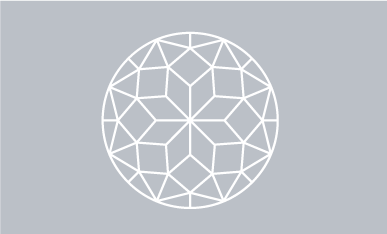 Round Diamond
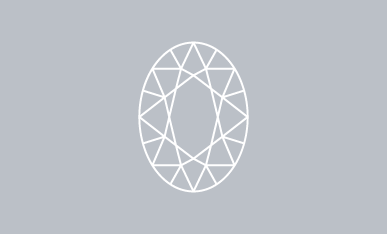 Oval Diamond
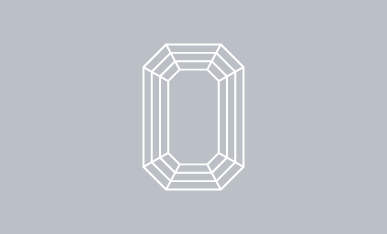 Emerald Diamond
 Marquise Diamond
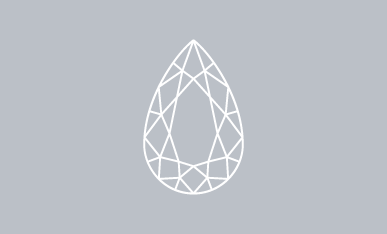 Pear Diamond
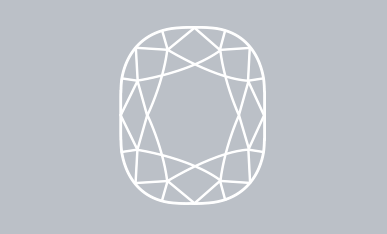 Cushion Diamond
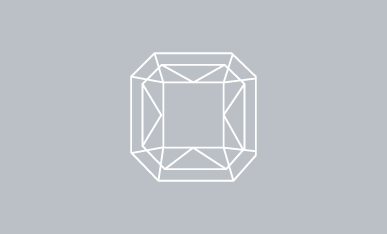 Radiant Diamond
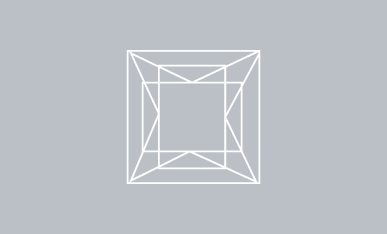 Princess Diamond
Round
The most popular shape is the Round Brilliant Cut which commands more of a premium per carat because more of the rough is cut away to form the round shape.
Oval
An oval diamond has brilliance that is similar to a round diamond. The oval shaped diamonds can accentuate slender, long fingers. The length-to-width ratio is important and will determine the diamond’s outline. Ratios between 1.33 and 1.66 are most traditionally accepted for ovals.
Emerald
The emerald cut diamond is among the most classic of diamond shapes. Inclusions are more visible in the emerald cut. Because of their design, rectangular cut diamonds require more weight to be directed toward the diamond’s depth to maximize brilliance. Depth percentages of 70% to 78% are not uncommon.
Marquise
The Marquise Cut is a regal, elongated shape with both ends tapered. When choosing an elongated diamond be careful to avoid the ‘bow-tie’ effect. Also, with a marquis cut the length to width ratio should be considered.
Pear
Although this shape is most often used in pendants, an elongated pear shape can create a slimming effect on the finger. The preferred length-to-width ration is between 1.45 and 1.75.
Cushion
This unique shape harkens after an older cut that is popular again. Cushions typically have rounded corners and larger facets which can increase their brilliance. Cushion-cut diamonds are available in shapes ranging from square to rectangular or oval. Some cushions have soft, bowed out sides and others have straight edges. Each cushion outline, shape and brilliance is unique.
Radiant
The radiant cut is a beautiful combination of the classic emerald cut and the sparkle of the round brilliant. Because of their design, rectangular cut diamonds require more weight to be directed toward the diamond’s depth to maximize brilliance. Depth percentage of 70% to 78% are not uncommon.
Princess
This shape is a perfect choice if you prefer a square or rectangular outline but want the brilliance of a round. Because of their design, square cut diamonds require more weight to be directed toward the diamond's depth to maximize brilliance. Depth percentages of 70% to 78% are not uncommon.
Square Emerald
A Square Emerald or "Asscher" cut is a step cut with angled corners and rows of pavilion and crown facets that run parallel to the girdle. “Asscher” is a term commonly used in the marketplace to describe these square Emerald cuts. The term is derived from the Asscher family name. The Royal Asscher Diamond Company currently produces the “Royal Asscher” cut, which is a patented square step cut with an extra row of facets on top and bottom, a notable high crown, and 74 total facets.
Old European
Diamonds cut into this shape possess a high crown, small table, and a large, flat culet. With 58 facets, it is the predecessor of today’s modern round brilliant cut. The Old European cut dates to the 1800s and was used mostly during the Victorian, Edwardian and Art Nouveaux eras.
Rose
The rose cut features a flat bottom with a dome-shaped crown, rising to a single apex. With anywhere from 3 to 24 facets, a rose cut diamond resembles the shape of a rose bud. The rose cut dates to the 1500s and remained common during the Georgian and Victorian eras.
Color
Fancy color diamonds in well defined colors including red, pink, blue, green and canary yellow, are highly prized and particularly rare, but in traditional diamonds the best color is no color at all.
These diamonds are graded starting at D for colorless diamonds and continuing through the alphabet to Z, for yellowish ones. While many diamonds appear colorless, they may actually have subtle yellow -brown tones in color grades of M to P.
Top
Carat
A carat is equivalent to one fifth of a gram (.007ounces) and is divided into 100 points. All other characteristics being equal, the larger the diamond, the more rare, the higher the price per carat. For example, a two carat diamond will cost far more than twice the price of a one carat diamond of the same quality.
Once you have determined what cut, color, and clarity grade you are looking for in a diamond, it is easy to determine the carat weight of diamond that will fit within your budget. Our experts at Donald Haack Diamonds and Fine Gems can educate you in all the 4 C’s and help you make that all important choice in a quality diamond.
| Carat Size | Physical Size |
|---|---|
| ¼ Carat | 4mm |
| ½ Carat | 5.2mm |
| ¾ Carat | 5.9mm |
| 1 Carat | 6.5mm |
| Carat Size | Physical Size |
|---|---|
| 1.5 Carat | 7.4mm |
| 2 Carat | 8mm |
| 2.5 Carat | 8.8mm |
| 3 Carat | 9.4mm |
| Carat Size | Physical Size |
|---|---|
| 3.5 Carat | 9.7mm |
| 4 Carat | 10.4mm |
| 4.5 Carat | 10.8mm |
| 5 Carat | 11.2mm |
Top
Clarity
Clarity refers to the presence or absence of inclusions found in the diamond. The fewer and smaller the inclusions, the less likely they will interfere with the passage of light through the diamond. Grading for clarity ranges from Flawless to Imperfect. At Donald Haack Diamonds and Fine Gems, you will be able to examine the clarity of your diamond under binocular magnification.
IF - Internally Flawless
Free from internal blemishes. No inclusions visible under 10X magnification. Very rare and beautiful diamonds.
VVS - Very Very Slightly Included (Minute)
Very difficult to see flaws or inclusion under 10X magnification. This is an excellent quality diamond.
VS - Very Slightly Included (Minor)
Inclusions are not typically visible and difficult to locate under a 10X magnification. Less expensive than the VVS and IF.
SI - Slightly Included (Noticeable)
Inclusions are easy to locate and very visible under 10X magnification and may be visible with the unaided eye. Still a good diamond value.
I - Included (Obvious)
Medium or large inclusions or external blemishes which are usually obvious to the naked eye under favorable lighting conditions.
I1
SI1
SI2
VS1
VS2
VVS2
Top
Certification
"No two diamonds are alike and neither are their grading certificates."
A survey by RapNet -The Rapaport Diamonds Trading Network found significant differences between laboratories grading the same diamond” says Avi Kravitz (Rapaport News). They ranked the laboratories in order of accuracy and consistency and GIA – The Gemological Institute of America ranked number one.
Jewelry Insurance News, in their newsletter (May 2011), recommended that their agents and underwriters rely on reports from reputable labs which they listed as GIA, AGS and GCAL.
Our gemologists will help answer any further questions with regard to certification to ensure that you purchase an accurately graded diamond.
Top